
About the shop
A neighbourhood tailor, at the same address.
YL Clothes (英利洋服) is a tailoring and alteration shop on Bukit Panjang Ring Road. We adjust the fit of everyday clothing, repair what has worn out, make garments to measure and look after the practical pieces around them.

Our story
A working tailor shop on Bukit Panjang Ring Road.
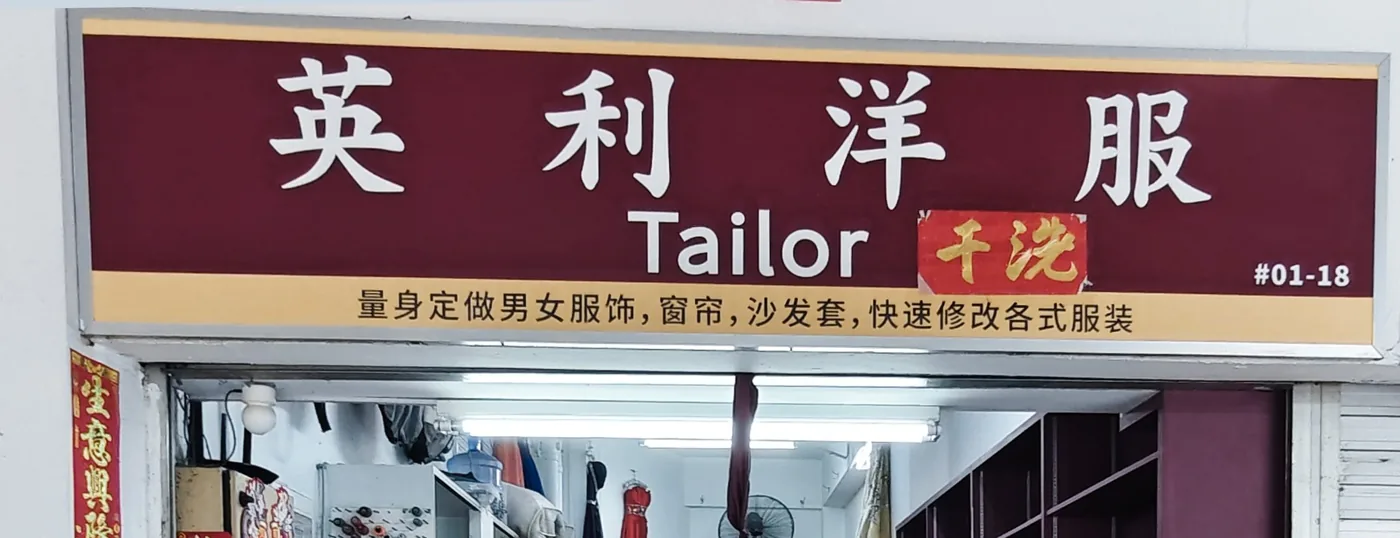
YL Clothes (英利洋服) trades from unit #01-18 at 259 Bukit Panjang Ring Road. Above the entrance, the signboard reads Tailor and 干洗, then lists made-to-measure clothing for men and women, curtains, sofa covers and quick alterations. That list is a fair summary of the work that comes through the shop.
Most jobs begin with a garment and a question: can this be taken in, let out, shortened, repaired, or made to sit better? We look at the fabric and the construction, explain what is realistic, and settle the scope before anything is cut.
The shop looks after individual customers and business customers — retailers, uniform suppliers and organisations that need garments adjusted in quantity. Both are assessed the same way: first the garment, then the advice, then the work.
On the signboard 英利洋服 · Tailor · 干洗 · 量身定做男女服饰,窗帘,沙发套,快速修改各式服装
Read the sign
The sign says what the shop does.
The signboard is not marketing copy; it is a service list. It names tailoring, dry cleaning, made-to-measure clothing, curtains and sofa covers, and quick alterations. If what you need is on that list, it is worth asking about.
- Tailoring and made-to-measure clothing for men and women
- Dry cleaning (干洗)
- Curtains and sofa covers
- Quick alterations to all kinds of clothing
What we work on
Clothes, uniforms, soft furnishings and the repairs in between.
A short list of the work that comes through the shop. If your item is not listed, ask anyway — the answer usually starts with a look at the garment.
Alterations
Hems, waistlines, sleeves, side seams and general fit adjustments for clothes you already own.
Repairs
Zips, seams, tears, buttons and linings, assessed for a repair that makes the garment wearable again.
Tailoring
Pants, shirts, jackets and suits, worked with attention to fabric, structure and finishing.
Uniforms
Staff uniforms adjusted and repaired, from a single garment to a batch for a team.
Traditional garments
Traditional clothing assessed individually, with the fabric and construction in mind.
Curtains & sofa covers
Curtains and sofa covers made to measure, the kind of work the shopfront sign names directly.
Explore alterations Explore tailoring Explore repairs Business & corporate Our work & shop
Every request is assessed before price and timing are confirmed. Complex, traditional or time-sensitive work is best discussed before a special trip.
How we work
Three habits that shape every job.
These are working principles, not promises of a particular result — the garment always has the final say.
Assess before cutting
The garment is examined and the options are discussed before work starts, so the scope is clear at collection.
Explain the options
We say what is possible, what is not, and where a repair may serve you better than an alteration.
Respect the garment
Adjustments should suit the fabric, the construction and the way you wear the piece, not just the measurement on paper.
Communication
Tell us in the language you think in.
Staff at the shop can help in English, Mandarin, Malay and Tamil. If it is easier to describe a fitting in one of these languages, say so — it makes the conversation more precise.
For a straightforward alteration, bringing the garment in is usually the quickest way to a clear answer. If you cannot visit yet, send the details through the contact form and we can tell you what to bring.
- Bring the garment, or a clear photograph of it
- Describe what feels wrong with the fit or finish
- Mention delicate, traditional or special-care fabrics before the visit
Next step
Start with the garment, or with a question.
Bring the item to the shop, or send an enquiry with a description. For business work, include the garment type and an estimated quantity so the request can be assessed properly.